
Effective mental health advocacy: step-by-step guide

Mental health stigma is not fading quietly into the background. Despite decades of awareness campaigns and growing public conversation, millions of people still face barriers to care, understanding, and support. For advocates, activists, and community leaders, this creates a frustrating paradox: the need is urgent, yet progress feels slow. This guide cuts through the noise and gives you a practical, research-backed roadmap for advocacy that actually works. You will learn how to prepare, take action, measure results, and adapt your approach so that your efforts create real, lasting change in the communities you serve.
Table of Contents
Key Takeaways
Point | Details |
Tailor advocacy to context | Effective advocacy adapts to specific challenges and social considerations in work, community, or school settings. |
Engage and measure impact | Track involvement and outcomes so your efforts remain credible and make a sustained difference. |
Address stigma strategically | Combat misconceptions with nuanced, evidence-based messaging to reduce barriers for those in need. |
Prioritise inclusivity | Focus on marginalised and underserved groups to ensure your advocacy is equitable and widespread. |
Understanding the mental health advocacy landscape
Before you can change minds, you need to understand what you are up against. The landscape of mental health advocacy is shaped by deeply rooted attitudes, structural shortcomings, and a persistent gap between what people know and what they believe. Knowing these dynamics is not discouraging; it is essential preparation.
Public perception of mental health conditions varies widely depending on the diagnosis. Stigma persists differently across conditions: psychosis tends to trigger fear, while depression is often dismissed as weakness. These are not the same problem, and they cannot be solved with the same message. Workforce shortages, treatment gaps, and the spread of misinformation online compound the challenge further. Advocates who treat stigma as a single, uniform issue risk missing the mark entirely.
Structural barriers are equally significant. Many communities lack access to qualified mental health professionals, and funding for community-based mental health programmes remains inconsistent. These systemic issues mean that advocacy must operate on multiple levels simultaneously, from changing individual attitudes to influencing policy and resource allocation.
Inclusivity is not optional in this work. Research consistently shows that tailoring strategies to specific contexts, whether a workplace, a school, or a community centre, produces better outcomes than generic campaigns. Marginalised groups, including those from lower socioeconomic backgrounds, often benefit least from one-size-fits-all interventions. Effective advocacy must actively seek out and centre the voices and experiences of those most affected.
Here are the key challenges you should expect to encounter:
Stigma variation: Fear-based stigma around psychosis differs fundamentally from shame-based stigma around depression
Misinformation: Inaccurate portrayals in media and online spaces undermine evidence-based messaging
Workforce gaps: Shortages of trained mental health professionals limit the reach of support services
Structural inequality: Lower socioeconomic groups face compounding barriers to both advocacy and care
Generalised campaigns: Broad messaging often fails to resonate with specific communities
“Effective anti-stigma campaigns must distinguish between stigma types and tailor their approach to the specific context and population they are addressing. Generic messaging is rarely enough.”
Recognising these layers of complexity is what separates well-intentioned advocacy from genuinely impactful work.
Preparing to advocate: skills, tools, and mindset
With the landscape in mind, it is vital to prepare yourself with the right tools and attitudes before taking action. Advocacy without preparation is like speaking into a microphone with no audience. The groundwork you lay now determines how far your voice travels.

The core skills every advocate needs include clear communication, active listening, empathy, and a solid working knowledge of mental health issues. You do not need to be a clinician, but you do need to understand the difference between a mental health condition and a crisis, and you need to be able to explain that difference to someone who has never thought about it before.
Resources matter enormously. Established campaigns, training materials, and community networks give you a foundation to build on rather than starting from scratch. The Take Action campaign results from a RAND evaluation showed that the campaign reached over 25% of adults and 33% of youth, increasing awareness, strengthening community connection, and mobilising action. Events built trust in ways that digital content alone could not replicate. This is a powerful reminder that real-world engagement remains irreplaceable.
Pro Tip: Before launching your own initiative, research existing campaigns in your area. Joining an established network gives you credibility, resources, and an audience that would take years to build independently.
Here is a practical overview of essential advocacy tools:
Tool | Purpose | Best used for |
Social media platforms | Raising awareness and sharing stories | Broad audience reach |
Community events | Building trust and direct engagement | Local mobilisation |
Policy briefs | Influencing decision-makers | Legislative advocacy |
Training workshops | Upskilling advocates and allies | Sustained capacity building |
Peer support networks | Providing lived-experience perspectives | Community credibility |
Mindset is the often-overlooked element. Persistence matters because change is slow. Adaptability matters because what works in one community may fall flat in another. And respect for lived experience is non-negotiable. People who have personally navigated mental health challenges are not case studies; they are co-advocates whose insight strengthens every strategy you develop.
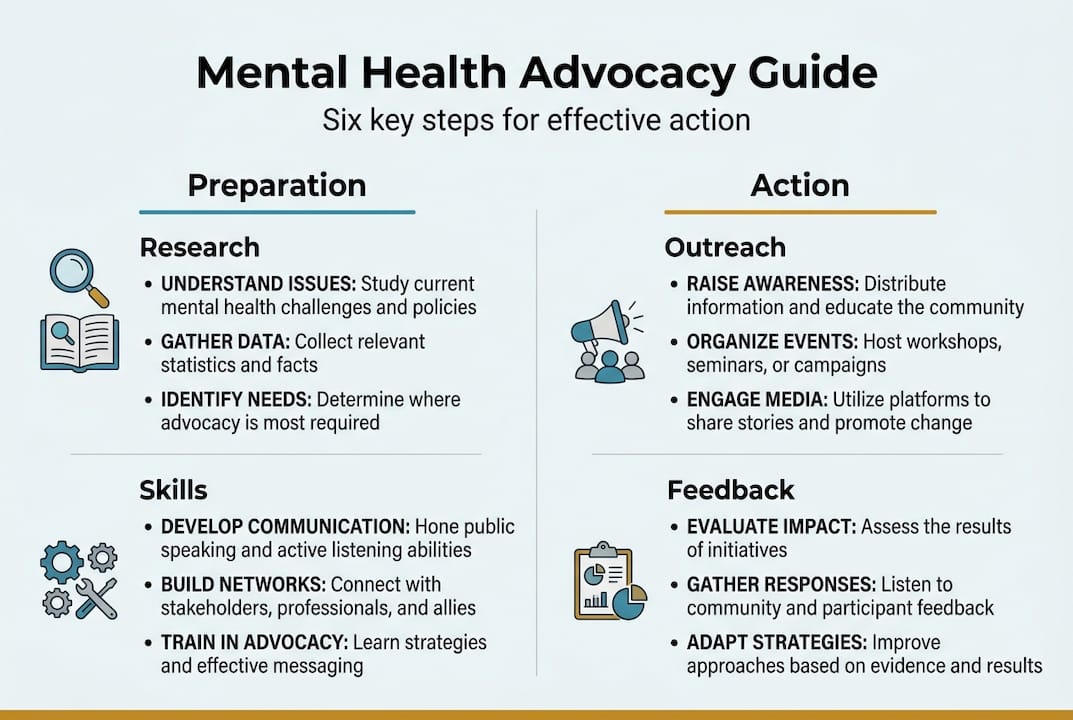
Step-by-step: how to advocate for mental health
Armed with the essential tools and mindset, it is time to take practical steps that drive genuine change. A structured approach keeps your efforts focused and measurable.
Identify the specific issue: Narrow your focus. Are you addressing workplace stigma, youth mental health, or access to services? Specificity makes your advocacy more persuasive and easier to evaluate.
Gather supporting evidence: Use research, statistics, and local data to build your case. Evidence transforms personal conviction into credible advocacy.
Engage affected communities: Speak with the people you want to support before deciding how to support them. Respectful, two-way dialogue prevents well-meaning but misaligned interventions.
Select your advocacy methods: Choose approaches that suit your audience, resources, and goals.
Design your action plan: Set clear timelines, assign responsibilities, and define what success looks like.
Take action and document everything: Record what you do, who participates, and what responses you receive.
Measure and iterate: Assess your results honestly and adjust your approach based on what you learn.
Research supports the value of structured, targeted advocacy. A randomised controlled trial found that a legislative advocacy programme significantly increased knowledge among parents of children with disabilities immediately after the intervention. Structured learning and action produce measurable results.
Here is a comparison of common advocacy approaches:
Approach | Key benefit | Consideration |
Public awareness campaigns | Wide reach and visibility | Risk of generic messaging |
Policy and legislative advocacy | Systemic, lasting change | Requires sustained effort and expertise |
Peer support programmes | High credibility and trust | Needs careful facilitation and boundaries |
Storytelling and media | Emotional resonance | Must protect individuals’ dignity and privacy |
Pro Tip: Track your advocacy programme outcomes from the very beginning. Even simple records of attendance, feedback, and awareness shifts make your work far more persuasive to funders, policymakers, and community partners.
Troubleshooting and avoiding common pitfalls
Implementing advocacy is only half the challenge. Anticipating barriers helps ensure sustained impact, and knowing where advocates commonly stumble can save you significant time and energy.
One of the most frequent mistakes is treating stigma as a single, uniform problem. As noted earlier, advocacy challenges include the reality that fear-based stigma around psychosis and shame-based stigma around depression require entirely different responses. A campaign that works brilliantly for one may actively alienate the audience of the other.
Advocacy burnout is real and underestimated. This work is emotionally demanding. You will encounter resistance, indifference, and sometimes outright hostility. Building in regular reflection time, peer support, and clear boundaries around your advocacy role is not a luxury. It is a necessity for long-term effectiveness.
Misinformation is another persistent threat. Before sharing any statistic or claim, verify it through credible sources. Sharing inaccurate information, even unintentionally, damages your credibility and can set back broader advocacy efforts.
Here are the most common pitfalls to watch for:
Generic messaging: Fails to connect with specific communities or stigma types
Neglecting marginalised groups: Interventions less effective for lower socioeconomic groups when strategies are not tailored
Ignoring feedback: Advocacy built on theory rather than community input loses relevance quickly
Burnout: Advocates who do not protect their own wellbeing cannot sustain their work
Unverified claims: Misinformation erodes trust faster than almost anything else
“Nuanced, non-generic anti-stigma efforts that distinguish between conditions and communities are not just best practice. They are the baseline for doing this work responsibly.”
Planning for inclusivity from the outset, rather than retrofitting it later, is one of the most powerful steps you can take to avoid these pitfalls.
Measuring and sustaining your advocacy impact
To guarantee your efforts create lasting value, it is essential to measure and build upon your results. Without measurement, advocacy risks becoming performative rather than transformative.
Start by setting clear, specific goals before your initiative launches. Vague aims like “raise awareness” are impossible to evaluate. Instead, define what awareness means in your context: more people attending a workshop, a measurable shift in attitudes, or a policy change at a local level.
Here are the key elements to monitor:
Participation rates: How many people are engaging with your initiative?
Awareness shifts: Are participants more informed after engaging with your campaign?
Trust levels: Do community members feel more connected and supported?
Mobilisation: Are people taking action as a result of your advocacy?
Feedback quality: What are participants saying, and how can you use that to improve?
The numbers from well-run campaigns demonstrate what is possible. A campaign reaching 25% of adults and 33% of youth, while simultaneously building community trust and mobilising action, shows that structured, evidence-informed advocacy produces real results.
The World Health Organisation emphasises that inclusive policy processes, cross-sectoral collaboration, and strong governance are essential for sustainable mental health progress. These principles apply at every scale, from a community group to a national campaign.
Documenting and sharing your outcomes is not just about accountability. It builds credibility, attracts future support, and contributes to the broader evidence base that the entire advocacy community can draw on. Your results, however modest, matter.
Why effective advocacy requires nuance and persistence
Looking across these steps, what stands out is that successful advocacy is dynamic, not static. The most common failure in mental health advocacy is not a lack of passion. It is a lack of adaptability.
Generic campaigns feel safe because they avoid controversy and require less contextual knowledge. But the evidence is clear: interventions are less effective for lower socioeconomic groups when strategies are not tailored to their specific circumstances. When we default to broad messaging, we consistently leave behind the communities that need support most.
Real advocacy demands that you listen before you speak, adjust when the evidence tells you to, and remain honest about what is and is not working. It means sitting with discomfort when your best efforts fall short, and choosing to learn from that rather than defend your original approach.
The advocates who create lasting change are not those with the loudest voices. They are those who combine genuine curiosity about the communities they serve with the persistence to keep showing up, refining their approach, and building relationships over time. That is the standard worth holding yourself to.
Take the next step: join the movement for better mental health
If you are ready to turn intent into impact, connecting with dedicated advocacy networks makes it far easier to find your footing and amplify your efforts.

Michelle Akpata’s philanthropy initiatives bring together advocates, community leaders, and changemakers committed to making mental health support more accessible and less stigmatised. Whether you are just beginning your advocacy journey or looking to deepen your existing work, you will find practical advocacy resources and a community of like-minded individuals ready to support your efforts. Joining a movement grounded in lived experience and evidence-based practice is one of the most powerful steps you can take.
Frequently asked questions
What are the most impactful ways to advocate for mental health?
The most effective approaches include raising awareness through structured campaigns, engaging policymakers directly, and supporting affected communities through peer-led initiatives. Evidence shows that well-designed campaigns can reach significant proportions of both adults and young people while building lasting community trust.
How can I overcome stigma when advocating for mental health?
Use evidence-based messages, differentiate between stigma types such as fear around psychosis and perceived weakness around depression, and share real stories with dignity. Nuanced anti-stigma campaigns that distinguish between conditions consistently outperform generic awareness messaging.
How do I measure the success of my mental health advocacy?
Track participation rates, awareness shifts, trust levels, and community mobilisation, then collect honest feedback to refine your approach. Structured evaluation, as demonstrated by campaign measurement methods, gives your work credibility and helps attract future support.
What challenges should I expect as a mental health advocate?
Expect persistent stigma in varied forms, resource shortages, misinformation, and uneven impact across social groups. Understanding these ongoing advocacy challenges from the outset allows you to plan more realistic, resilient strategies.
Recommended


Comments